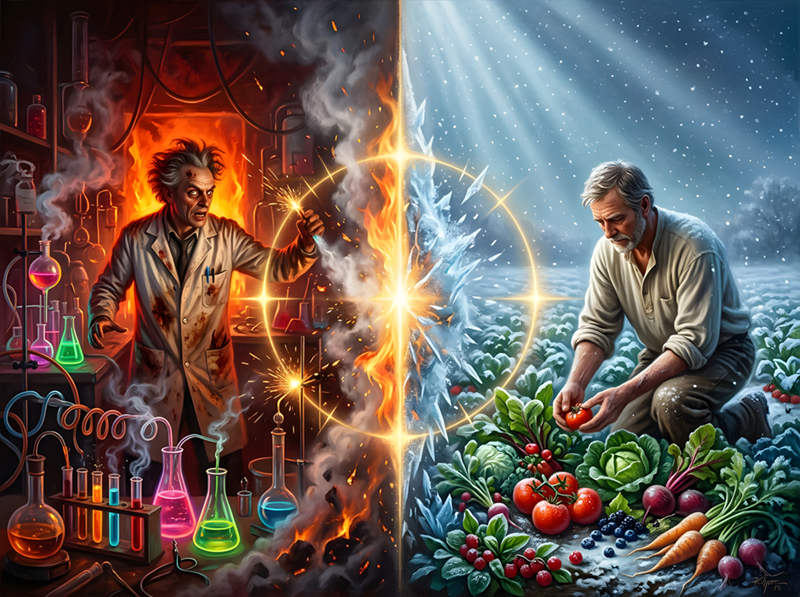
On one side of the line, a farmer pulling food from the cold ground with his bare hands. On the other, a chemist in a lab coat conjuring it out of test tubes and glowing liquids. Your body can tell which side is which — even when the label can’t.
I keep coming back to a simple question whenever I’m standing in a grocery aisle holding a package and reading the back of it: would this have existed two hundred years ago?
Not “is it tasty.” Not “is it low-carb.” Just — is this food, in the way my great-grandparents would have understood the word? Something that grew, swam, grazed, or came off a plant? Or is it something that was engineered — assembled from extracted fragments and synthetic compounds, colored with a dye that started as crude oil, and shelf-stabilized with a chemical that didn’t exist until a factory invented it?
That question is the whole reason I wanted to write this one. I’m not here to scare anyone, and I’m definitely not here to tell you what to eat. I’m here to hand you a flashlight and point it at a part of the food supply most of us walk past without a second glance — and then let you do your own digging. Because once you start pulling this thread, you can’t un-see it.
Your Body Was Built for One Side of This Line
Here’s the idea that reframed how I think about all of this.
Your body is the product of an almost unimaginable stretch of time spent eating whole, natural foods — meat, fish, eggs, vegetables, fruit, nuts, the occasional bit of honey. Every enzyme, every metabolic pathway, every signal your gut sends your brain was shaped to handle that kind of fuel.
Now consider how recent the alternative is. Most of the synthetic substances packed into modern processed food have only existed for a handful of decades. That’s a blink. And when your body meets a compound it has no evolutionary blueprint for — no enzyme designed to break it down, no pathway built to recognize it — it has to improvise. Scientists sometimes call this metabolic unfamiliarity. Your system simply doesn’t have the instructions.
Sometimes that improvising is harmless. Sometimes it isn’t. And the honest truth is that for a lot of these substances, nobody fully knows yet — which is exactly why I think it’s worth paying attention now rather than waiting twenty years for the verdict.
“Processed” Isn’t the Enemy. Ultra-Processed Is a Different Animal
Let me be fair, because this matters. Humans have processed food for thousands of years. Freezing, drying, fermenting, canning, salting, smoking — these are all forms of processing, and they’re fine. Cheese is processed. So is plain yogurt. So is a frozen bag of wild salmon.
The thing worth watching isn’t processing in general. It’s the far end of the spectrum that nutrition scientists call ultra-processed food — industrial products built mostly from cheap extracted ingredients (protein isolates, modified starches, refined oils, syrups) and then held together with additives you’d never find in any kitchen: synthetic emulsifiers, artificial colors, flavor compounds, and preservatives.
The simplest way I’ve heard it put: if a product’s ingredient list is full of things you couldn’t buy at a normal store and wouldn’t cook with at home, you’re probably holding an ultra-processed food.
And here’s why this jumped from “interesting theory” to “I should really care about this” for me: 2025 was the year the science caught up. For a long time, the link between ultra-processed food and poor health was mostly observational — researchers noticed that people who ate more of it tended to be sicker, but couldn’t prove the food itself was the cause. That changed. A wave of experimental, clinical, and population studies converged, including a controlled trial showing that ultra-processed diets drove weight gain and metabolic problems even when calories were matched — meaning it wasn’t just “these foods are fattening.” Something about the food itself was doing damage. Major reviews in The Lancet and from places like Harvard Health now tie heavy ultra-processed consumption to higher risks of heart disease, type 2 diabetes, obesity, and more.
More than half of the calories the average American adult eats now come from these foods. For kids, it’s higher. That’s not a fringe problem. That’s the default diet.
A Field Guide to Man-Made Food Substances
This is the part I really want you to take with you — not as gospel, but as a research list. These are the categories I personally try to steer around, with a plain-English note on what each one is and why it’s worth a closer look. I’d encourage you to look up every single one of these for yourself and form your own opinion.
- Artificial trans fats (partially hydrogenated oils) The proof of concept for this entire article. For decades these factory-made fats were everywhere — margarine, shortening, fried foods, baked goods. The science eventually became undeniable that they raise the kind of cholesterol that clogs arteries, and U.S. regulators ultimately determined they were no longer safe to add to food and pulled them from the supply. Sit with that for a second: a man-made food ingredient was used for generations, then formally removed once the harm was clear. It’s the cleanest possible example of “we didn’t know until we did.” They’ve largely disappeared from American shelves, but they’re worth understanding as the template for everything below.
- Petroleum-based synthetic dyes These are the bright, unnatural colors — the reds, yellows, and blues in candy, cereal, sports drinks, and snacks. The unsettling part for most people is where they come from: they’re synthesized from petroleum. Concerns about behavioral effects in some children, including links to hyperactivity and attention issues, have driven real regulatory momentum. As of 2025, U.S. health agencies announced a push to phase petroleum-based dyes out of the food supply by the end of 2026, and one dye, Red No. 3, was formally revoked. Natural color alternatives (beet, turmeric, spirulina, paprika) already exist — which raises the obvious question of why the synthetic versions were used for so long.
- Synthetic preservatives (BHA, BHT, TBHQ, sodium benzoate) These petroleum-derived chemicals keep packaged food from going rancid, and they’re hiding in an enormous range of products. Some have animal-study links to concerning effects and have sat on the books for decades without a fresh safety review. I wrote a whole deep dive on these four — including the genuinely alarming detail about what can happen when sodium benzoate meets vitamin C in the same bottle — so I won’t repeat it all here. (See: “The Preservatives in Your Food Were Never Food.”)
- High-fructose corn syrup and refined added sugars Cheap, industrially produced, and engineered into a staggering number of products — including plenty of “savory” ones you’d never suspect. The issue isn’t a sweet treat now and then; it’s the relentless background flood of added sugar that the modern food supply delivers, and the metabolic toll that takes over time.
- Artificial sweeteners (sucralose, aspartame, saccharin) The “zero calorie” trade-off that isn’t always free. The evidence here is genuinely mixed and still developing, so I won’t overstate it — but the angle I find most compelling is the gut. Research has suggested that even amounts within official limits can shift the makeup and behavior of the gut microbiome in ways that may not serve metabolic health. That’s the ecosystem your whole body leans on, which is why I lean toward naturally-derived options like monk fruit, allulose, and stevia instead.
- Synthetic emulsifiers and texturizers (polysorbate 80, carboxymethylcellulose, carrageenan, and similar) These are the invisible workhorses — they keep oil and water from separating and give processed food its smooth, stable texture. Most people have never heard of them, and that’s exactly why they’re worth knowing. Emerging research, including 2025 animal work, points to effects on the gut lining and microbiome and even effects that may carry across generations. This is newer science, so file it under “watch closely,” not “settled” — but it’s moving fast.
- Industrial seed oils (soybean, corn, canola, cottonseed, and the like) I’ll be straight with you, because this one deserves honesty: the science here is genuinely debated. Mainstream institutions consider these oils fine, while the ancestral-health and keto community points to concerns about the heavily industrial extraction process, oxidation, and the lopsided omega-6 load of the modern diet. My personal position is that I avoid them and cook with butter, tallow, olive oil, and avocado oil instead — but I want you to read both sides and decide for yourself. (See: “Seed Oils: What’s Actually In Your Food and What to Use Instead.”)
- Artificial and “natural” flavors / flavor enhancers That tidy little phrase “natural and artificial flavors” can hide a proprietary cocktail of dozens of compounds you’ll never see itemized. On its own it may be no big deal — but it’s one of the most reliable signals that you’re holding an ultra-processed food engineered for hyper-palatability rather than nourishment.
The Filter I Actually Use
I’m not perfect about any of this, and I’m not asking you to be either. But here’s the simple, no-stress filter that’s made the biggest difference for me, and it doesn’t require memorizing a single chemical name:
Read the ingredient list, not the front of the box. The front is marketing. The back is the truth.
Apply the great-grandmother test. If a reasonable person from a century ago would look at the ingredients and recognize them as food, that’s a green light. If half of them read like a chemistry exam, that’s worth a pause.
Shorter is usually better. A list of three or four real ingredients beats a paragraph of unpronounceable ones almost every time.
You don’t have to be a purist to win here. Even shifting the ratio of your week toward real, whole food — more of what the farmer pulls from the ground, less of what comes out of the lab — moves the needle. This isn’t about perfection. It’s about which side of that dividing line your plate spends most of its time on.
Do Your Own Digging
Everything I’ve laid out here is a starting point, not a finish line. I genuinely want you to look these substances up yourself, read the studies, read the rebuttals, and reach your own conclusions. Healthy skepticism cuts both ways — be skeptical of the food industry’s reassurances and of anyone (including me) telling you the sky is falling. The truth usually lives in the careful middle, and you’re more than capable of finding it.
The farmer and the chemist are both offering you something to eat. They are not offering you the same thing. Once you can see the line between them clearly, you get to choose — and that choice, made a few times a day, every day, adds up to your health over a lifetime.
Pick your side of the war.
The information in this article is for general educational purposes and reflects my own research and personal philosophy — it isn’t medical or dietary advice. Everyone’s body and health situation is different, so please talk with a qualified healthcare professional before making significant changes to your diet, especially if you have an existing health condition.