
Embark on a revolutionary weight loss journey with a keto Hawaiian Saimin that transports you to the vibrant islands while transforming your metabolism. This isn’t just a soup—it’s a carefully crafted nutritional strategy that combines the authentic flavors of Hawaii with cutting-edge weight loss science, proving that healthy eating can be both delicious and exciting.
The History of Hawaiian Saimin Soup
Saimin is a beloved noodle soup unique to Hawaii, with roots in the islands’ multicultural plantation history. It blends influences from Chinese, Japanese, Filipino, and Hawaiian cuisines, making it a true symbol of Hawaii’s diverse culture.
Origins in Plantation Era (Late 19th – Early 20th Century)
In the late 1800s to early 1900s, Hawaii’s sugar and pineapple plantations attracted immigrant workers from China, Japan, the Philippines, Korea, and Portugal.
These workers lived in plantation camps and often shared meals, leading to a fusion of different food traditions.
Chinese immigrants introduced noodle soups (similar to Cantonese mein), while Japanese immigrants contributed dashi (a light fish broth), and Filipinos and Koreans brought other seasonings and garnishes.
Over time, these elements combined into saimin, a simple but flavorful noodle soup that became a staple for locals.
Why is Saimin Loved by Hawaiians?
Comfort Food Tradition – Saimin is deeply ingrained in Hawaiian culture and evokes nostalgia for home-cooked meals.
Customizable & Affordable – Originally a budget-friendly dish, it can be customized with proteins like spam, char siu (Chinese roast pork), green onions, and kamaboko (fish cake).
Fusion of Cultures – It represents Hawaii’s unique blend of immigrant influences and the island’s history.
Served Everywhere – From small diners (saimin stands) to McDonald’s Hawaii locations, it remains an everyday favorite.
Modern Saimin
It is still a popular dish in local Hawaiian restaurants.
Some versions include ramen-style upgrades, spicier broths, or keto-friendly alternatives using zucchini noodles or shirataki noodles.
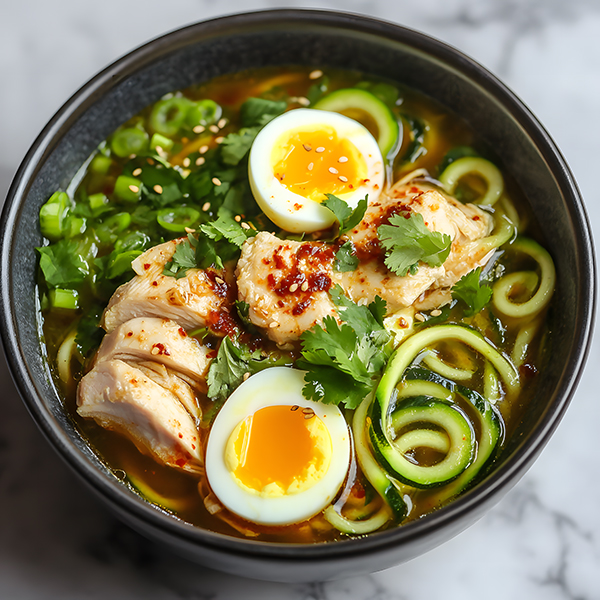
Ultimate Low-Carb Island Saimin Soup Nutrition Feast
Description
Ingredients:
Soup Base:
6 cups chicken bone broth
2 cups water
1/4 cup coconut aminos (low-carb soy sauce alternative)
2 tbsp rice vinegar
1 tbsp ginger, freshly grated
2 cloves garlic, minced
1 tsp sesame oil
Protein and Vegetables:
1 lb chicken thighs, thinly sliced
4 large zucchini, spiralized into noodles
2 green onions, thinly sliced
1/4 cup fresh cilantro, chopped
2 soft-boiled eggs
1/4 cup sliced shiitake mushrooms
Seasoning:
1 tsp salt
1/2 tsp white pepper
1 tbsp chili oil (optional)
Instructions:
Broth Preparation:
In a large pot, combine chicken bone broth and water
Add coconut aminos, rice vinegar, grated ginger, and minced garlic
Bring to a gentle simmer
Reduce heat and let flavors meld for 10 minutes
Chicken Preparation:
Season chicken thighs with salt and white pepper
In a separate pan, cook chicken until golden and fully cooked
Slice thinly and set aside
Zucchini Noodles:
Spiralize zucchini into noodles
Lightly salt and let sit for 5 minutes
Pat dry with paper towels to remove excess moisture
Soup Assembly:
Add sliced shiitake mushrooms to broth
Cook for 2-3 minutes
Add zucchini noodles
Cook for 1-2 minutes (do not overcook)
Add cooked chicken slices
Finishing Touches:
Soft-boil eggs (6-7 minutes)
Peel and halve eggs
Ladle soup into bowls
Top with green onions and cilantro
Add soft-boiled egg halves
Drizzle with chili oil if desired
Serving Suggestions:
Serve immediately while hot
Garnish with extra cilantro
Pair with small side of kimchi
Can be made ahead and assembled just before serving
Meal Prep Tips:
Prepare broth and chicken in advance
Store zucchini noodles separately to prevent soggy texture
Broth can be refrigerated for 3-4 days
Eggs can be soft-boiled ahead of time
Reheat broth gently to maintain flavor
Estimated Cost: $6-8 per serving
Nutritional Values (Per Serving):
Calories: 380
Total Fat: 22g
Saturated Fat: 6g
Protein: 30g
Net Carbs: 8g
Fiber: 4g
Cholesterol: 220mg
Sodium: 580mg
